DID IT ALL GET REAL? I GUESS IT’S REAL ENOUGH
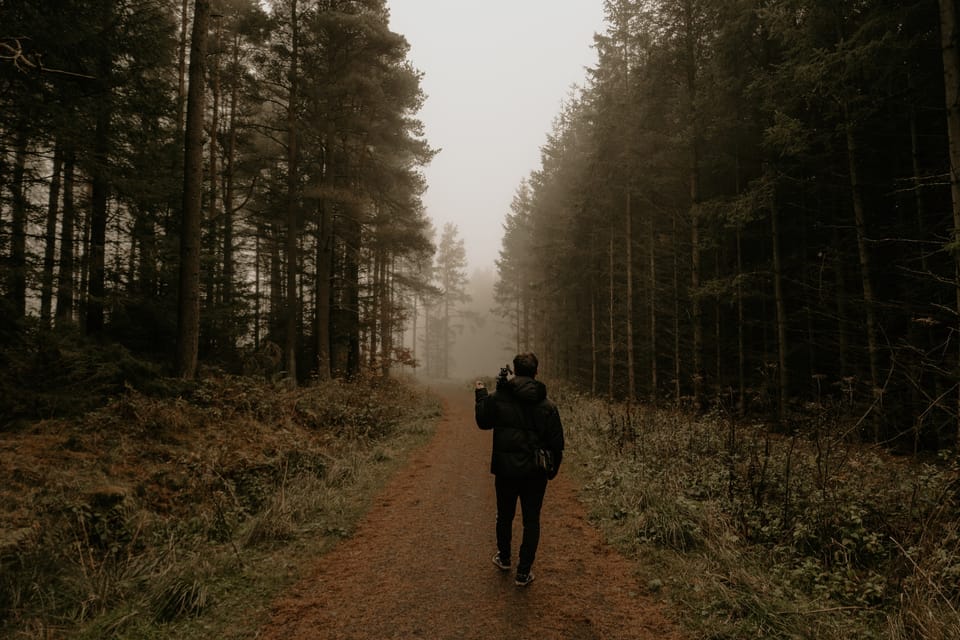
I took a drive out to the Lands End trail this morning to clear my head and see if my playlist choices worked. The air is brisk right now but the sun is out in San Francisco, giving this city a special kind of sublime warmth. When I got to the entrance of the walking trail, there was a bevy of activity—park rangers, police, hikers, and confusion. I’m still not sure what was going on. Lands End is one of the most beautiful places in San Francisco but it rests at the edge of the world. The thought of the law enforcement looking for someone that might have fallen from the cliff’s steep heights, into the limitless ocean, is gutting. I guess we’re all on the edge of something, regardless of how picturesque it might be. I hope it was nothing, and that it’s my assumptions playing tricks on me, but I’ll take the lesson regardless.
Bright Eyes - Easy/Lucky/Free
Toro Y Moi - Rose Quartz
Balance and Composure - Postcard
Cloakroom - Seedless Star
GZA - 4th Chamber (Feat. RZA, Ghostface Killah, and Killah Priest)
Have a Nice Life - Trespassers W
Death Angel - The Ultra-Violence
Julien Baker - Tokyo
Panda Bear - Bros
Saves the Day - Tomorrow Too Late
“Easy/Lucky/Free” is the moment Conor Oberst stopped being “the New Dylan” and became a doomsday prophet. Digital Ash in a Digital Urn gets some unfair opinions lobbed its way but I think that’s because the album represented an ideological shift for Oberst, who began to zoom out and ruminate on how technology would ultimately begin to devalue the nature of our reality. This seems to be Digital Ash’s lasting legacy more so than being the “electronic Bright Eyes album,” because without it, you don’t get the metaphysical longing of Cassadaga, the clustered and spiraling new wave of The People’s Key, or this year’s cosmic psychedelia of Down in the Weeds…” Sure, there’s more programming here that what Saddle Creek was used to in 2005, but it’s set against some processed slide guitar and some glitch heavy dissonance as the song’s coda hints at a bittersweet kind of release. This is all to say that for as different as it is, the Bright Eyes thread runs though to paint a bigger story of where we are and where we’re going. I often wonder what comes next once the screens we use become too much to handle, or ultimately useless for the life we really want. Maybe in the end, it’s a lot of crying over nothing but the kind of transition we find ourselves in now is worth some consideration or refocusing. At least Oberst seems to think so.
I’m fascinated at the idea of music as environment, sort of how Brian Eno’s Ambient 1: Music for Airports was famously arranged for use as a sonic installation in airports—to cultivate a certain mood. The older I get, the more interested I am in creating good environments for clear thoughts and music, particularly ambient music, has become essential to that exploration. I’m not interested in arrangements that fade into the background, but rather, ones that proactively shape a room’s atmosphere. While I wouldn’t categorize Toro Y Moi as an ambient artist, his approach to electronic music on “Rose Quartz” focuses on the kind of ambience I’m preoccupied in chasing. There’s a warmth to its pulsing back beat, a tenderness from his tenor, and a foggy quality to these synthesizers that all put me at peace. If there is ever a civic push for public sound installations, this would be at the top of my list.
It’s impossible to stargaze in a major city but capturing the enormity of that feeling is a strong substitute. For that reason, I’ve been enjoying Balance and Composure’s Light We Made as of late, a slickly produced modern rock record that eschews much of their emo-laden dissonance for a decidedly more nocturnal sprawl. “Postcards” falls somewhere in between the restorative chime of Pianos Become the Teeth and the gloomy nightmarescape of pre-cancellation Brand New. Nothing ever really explodes here but the sense of dread remains constant throughout. Jon Simmons shifts perspectives between a haunted past and the release of disintegration, the possibilities limitless against a tangle of twisting guitars and distant keyboards. Sometimes it’s hard to be alone and sit with how large everything can be, the scale of what we are as breathtaking as our grief. Sometimes, you need a song like “Postcards” to cope.
The moral arc of shoegaze is long but it bends towards doom metal. Cloakroom is not the only 10s group marrying a funeral death lurch with My Bloody Valentine guitar worship but they present an arresting contribution to the genre with Time Well. “Seedless Star’s” lumbering crunch is a like a gravity blanket for your soul, a collection of blooming riffs and dreamy vocals. For all the weight that’s present here, there’s also an incredible sense of lightness, an appreciation for the prospect at looking inward and discovering something hidden.
I have a theory that classic Wu-Tang records succeed because listeners are uncovering a mystery. The group’s mythology unfolded in the shadow of the underground, which is no surprise given the need to be initiated and connected by a broader set of acolytes. Like the martial arts movies that informed their aesthetic, early period Wu-Tang revealed itself slowly, luring you into the arena. The sonic through-line from 36 Chambers to Liquid Swords is clear, both of them featuring the kind of fog of war production that’s as eerie as it is confrontational, but it’s no less astounding how it all coalesced. “4th Chamber” is essentially a Wu-Tang song but with some added space station warble and phasing glitch as the mic trades hands. It’s a testament to how those who endeavor to brave the arena, and learn its secrets, will be handsomely rewarded.
Have a Nice Life really blew me away with last year’s Sea of Worry. While their prior albums seemed to rest in the middle of Floyidan prog and modern electronica, Sea of Worry was a rapturous interstellar approach to post-punk, and the album features more driving energy as a result. “Tresspasser W” might span the gamut of psychonaut riffing and Christopher Robin worship, but it’s pretty remarkable all the same.
My favorite metal genre is thrash metal. It has a relentlessness that marries well with complexity and precision. And even if you ignore S&M and S&M2, there is an aspect of thrash’s virtuosity that blends well with the more technical leanings of classical music. Unfortunately, Death Angel don’t get as much credit as the other Big 4 of 80s thrash. It’s shame because they play circles around Anthrax and incorporate the same menace as early period Metallica, serving as vanguards of the movement alongside Testament or Exodus before the shift to death metal in the 90s. “The Ultra-Violence” from Death Angel’s similarly titled 1987 album is a multi-suite instrumental, featuring the best the genre has to offer—zig-zagging riffs, break neck tempo changes, and explosive guitar pyrotechnics. The best thrash songs widen the scope of terrifying real-world horrors, forcing listeners to face the despair of one’s circumstances. That view is positively panoramic on “The Ultra-Violence.”
The lure of anonymity is strong. To disappear completely, to leave our mistakes behind presents a possible emancipation from our current suffering. I’ve always found that line of thinking problematic, because like our shadows, there is no erasure of our past choices, only the procrastination of processing. “Tokyo” follows that idea, the notion that you can’t escape the trauma of past car crashes when searching for love and acceptance. Julien Baker’s minor key strums eventually build to a revelatory crescendo and a painful lesson: the sting of transformation is necessary for us to become ready to accept the love we deserve.
Panda Bear songs are generally a fever-dream of Brian Wilson harmonies, warped by LSD. “Bros” is the best distillation of that if you can call it a distillation at nearly 12 minutes (and some acoustic guitar as a bonus). Yet where Animal Collective traffic in abrasion, there’s a softness and a dreamy quality to much of Person Pitch that is as pleasant as it is disorienting, without some of the carnivalesque aspects you’ll find on an Animal Collective record. I guess the end result is that if you’re trying to witness the “ineffable” through legal means, the orbital sound collage of “Bros” might just be the ticket for your ride.
We all spend a lot of time thinking about where we’ve been. Along the way, I think we get lost in nostalgia, not because we want to feel youthful, but because we want to relive the safety and comfort we used to have (or perceive that we used to have). “Tomorrow Too Late” explores that idea through a psychedelic daydream that’s one part Beatles, one part Weezer, as Chris Conley meditates on the pang of wanting to hold someone’s ghost in the beauty of now. I can’t say I’ve lived a long life at 33, but what I know of this life is that its about trade offs. Time and space are strange limiters in ways we can’t fully understand but we can always appreciate what they have to offer.
Originally published November 15, 2020 as part of Hella Vibes.